
Initial Ideas and Research
Benjamin Bardou:
https://vimeo.com/benjaminbardou
Liam Wong: https://www.liamwong.com/
Stylistically wise and the technology we used was largely inspired by the artist Benjamin Bardou an artist who uses Point Cloud technology to create a lot of his work, mainly his series of work titled Megapolis, this look creates a very futuristic and surreal feeling to his work, it also creates a look that I describe as capturing a moment in time like a photograph which can be literally explored, since nothing is really moving but the camera. We were shown this artist in our first lecture for our optional module VFX, and both me and James the person I collaborated with on this project got very interested on this look and wanted to use it for our work and this project as it also fit the module theme of spaces and places. So did more research into his collection "Megapolis" to see what I liked about his work most and what he wanted to portray with it.
One of the pieces that really intrigued me were: "La Cathédrale" which I liked as he uses this new technology to present an older building and this creates a nice contrast between the new and old, it also creates a feeling as if this is a video in the future documenting a building that has been lost to time and this is the only way to see it. In this he also uses a transitional effect where these points/pixels stretch through the whole screen and it then transitions onto the next shot, which I really liked.
"Lost in Tokyo" is another work of his I liked a lot in this piece Benjamin Bardou collaborates with Liam Wong, which is a photographer I have followed for a while and I liked how well their styles integrated together for this video, I liked how the point cloud technique that Benjamin uses makes the environment very abstract looking but you can still understand the initial real look of the video so it doesn't look like complete fantasy and is grounded in the real world, it also lets the skills of Liam's shine. I also liked the effect that Benjamin uses where at certain parts the points are quite spaced out between each other and you can look through the wall into the next street.
The last piece that really caught my attention was his work Shinjuku VR, in this like the others he uses the Point Cloud to create this surreal feeling but in this one he abstracts the points in a very abstract and interesting way for the video but he also had a VR playable version of the Point Cloud world and that really struck me I loved how so far he had created this simulations that you could explore in the videos but with this one you could actually explore yourself and even interact with the world as the points could be moved by the player. I really wanted to try and do a similar this to create a VR game but I did not know if this was possible as I didn't even know how to create and animate Point Cloud yet, so I didn't know if I would have time or even the abilities to do this.
I also looked at the meaning behind these works and as Benjamin describes on his website "This project was born from the same sentiment stated by Charles Baudelaire. Each MGLP episode is a poem and MEGALOPOLIS will be the collection of these poems.", which I found very interesting he also talks about "MEGALOPOLIS is a project born from the fascination of megacities." on an old instagram post which I again really liked as a reason, so I took these into account when conceptualizing our project.
.webp)
.webp)
.webp)
.webp)
.webp)
.webp)
.webp)
.webp)
RubenFro:
https://vimeo.com/rubenfro
Whilst trying to find other artist in this field to get a bigger range of inspiration and create my own style with this technique I realised there weren't many people that used this style f regularly mostly just people doing a one off experiment but I did find the artist who goes by Ruben Fro. RubenFro creates these point cloud videos similar to Benjamín Bardou but with some key differences, mainly in their style and the special effects he uses, for example Benjamin Bardou creates these stretching pixels effects at some parts whereas Ruben has a uses this animation where the points near the camera dissolve. The things I liked about Ruben's which I wanted to adopt into mine were the way portrayed the places he was filming, by keeping them true to the feel they create but adding his own twist to them with the simulacra style VFX and sound, I also really liked how he was able to tell a story through these animation he created. Lastly I liked the effect where the Point Cloud would basically break into small squares and then reassemble.


Deciding on Location & Idea:
James from the beginning really wanted to use this Point Cloud technique to record a church which I was perfectly happy to do, as I also liked the idea, however I felt it was too similar to Benjamin Bardou's work to the point of emulation rather than inspiration. In addition he didn't really have any meaning as to why we would be using point cloud for the church so I felt it was an underdeveloped idea, so I pushed him to get a more developed idea and I also gave ideas of my own like doing a car meet or concert to show how communities use spaces to gather and express themselves. His other idea that he gave which was to do a scan of the Barbican which I had never heard of so was interested and then I saw it was brutalist architecture which I had never fully looked into but I liked as a design look, so I was very much happy to go with this idea and is the one we chose. During experimenting I felt we still didn't have enough meaning for our idea, mainly because of the 1-on-1 tutorials with our tutors so discussed it more and James still wanted to do the church, we had also found that there was a church at the barbican so we decided to merge the 2 ideas together and show the contrast between the two.
It proved hard to some up with ideas and be more experimental in what we were portraying as we had a huge challenge ahead of ourselves, which was figuring out how to create the point cloud, most experimentation and research would have to go into that.
Looking into Brutalism:
After we decided on the idea I decided to do some research into brutalist architecture and it history so that I am able to portray it in a more interesting and accurate way. For this I used these sources: https://www.lrb.co.uk/the-paper/v38/n22/owen-hatherley/strange-angry-objects, https://www.modernism-in-metroland.co.uk/blog/bolshy-flatblock-the-buildings-of-a-clockwork-orange, https://mymodernmet.com/brutalist-architecture/, https://www.architecture.com/explore-architecture/brutalism, https://www.designingbuildings.co.uk/wiki/Brutalism, https://www.designingbuildings.co.uk/wiki/Cite_Radieuse and below are that information that shaped my ideas when creating the actual video, they influenced everything from aesthetic to the camera movements.
One of the points that I found interesting was how it was criticized, was because it felt unwelcoming and inhuman and that seemed to be one of the reason why it was used in the movie "A Clockwork Orange" to create a dystopian surreal look that would fit the film. We also want to create this sort of surreal and dystopian feeling in our video of course with different connotations however as we were inspired by the surreal feeling you get while walking around a brutalist place like the barbican.
One of the points that I read which heavily shaped my ideas of how I wanted present this work, was seeing how Le Corbusier saw the house as only a "machine for living in" and how a lot of brutalist architecture came from the modernism idea of creating architecture with purpose and brutalism did that so it could store a large number of people as there was a housing crisis, this made me want to give the barbican parts of the video a more purposeful look so any movements aren't waisted and if there are any it would look out of place.
Photographers Gallery "A Brief Revolution: photography, architecture and social space in the Manplan project":
We also visited the Photographer's Gallery as I had seen that they had an exhibition up that might help up with developing out meaning for this project. The exhibition was called "A Brief Revolution: photography, architecture and social space in the Manplan project" and included an archive of photographs which were taken during the late 1960s in Britain, talked issues of modernity and the revolution of mass housing through the photographs, by depicting how people lived in this newly modernised world. The 2 images that were most striking to me were the photograph "Onlookers by the lake watch the construction of Thamesmead, Greenwich, London" by Tony Ray-Jones and "Children playing in the precinct of low-rise housing, Tavy Bridge, Thamesmead, Greenwich, London" by Tony Ray-Jones again. The first one as the title implies is a picture of a group of people relaxing at a park/lake looking at the construction of a new modernised town, the thing I liked a lot about his image was that on the side of the part you have kids playing a lot of people enjoying their time there whereas the modern town in the background is completely barren, this was because it was still being constructed but it still creates a very nice contrast. Another thing I liked was how the picture was framed where rather than a optimistic look towards the future the picture is framed in a way that seems to me implying impending doom on the horizon almost reminiscent of old godzilla movies

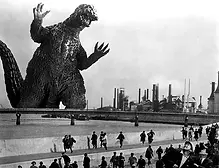
The other image depicts children playing in an area which seems to be brutalist architecture, and again creates contrast between this kids playing, which from the viewer's memory would link back to a playground but now they are playing in this many simple blocky structure which doesn't seem suitable for kids.

From this research I was able to develop my ideas of how I would show the contrast between the barbican and the church better, but again since these images were taken in the past when architecture like this was heavily criticized they depict the architecture a fairly negative light whereas with our project I want to be a bit more neutral and mainly ask questions as I personally like the look of brutalist architecture.
Project Proposal:
We had a project proposal where we would present our idea and get feedback on it, below is the powerpoint of the presentation. The feedback we got was mostly positive which encouraged us to get going forward with our idea. I felt that most of the "bad" feedback we got was because we weren't able to portray our ideas clearly. Creating the power point was also very useful the group as we were able to get a clearer idea of what we both felt the project was about through collaborating on this communicating it in clearer sentences reathen in simple conversation. Lastly the teachers recommended some artist to look into which played with the idea of a virtual camera and what it means, like Victor Burgin another british artist who was known for his photography and conceptual art in the 1960s but what would interest us was his 3D software artwork. I did look into this artist but I could not delve into their work and their ideology as much as I wanted to because I did not have the time to with trying to figure out his project and the other project I was working on for my VFX module, and I didn't have enough time or material to write an analysis.